Source: Vinventions — Technical Articles (eu.vinventions.com)
About This Study
By Meistermann Eric1 & Jean Baptiste Diéval2
The role of oxygen in the ageing of wine has been known since Louis Pasteur. However, it is only in the last fifteen years — thanks to improvements in measurement of total oxygen in bottles and developments in closure technology — that significant progress has been made in controlling oxidation phenomena in bottled wines. The current trend of reducing sulphites in wines and the need to ensure proper conservation has given even greater importance to this issue.
1 Institut Français de la Vigne et du Vin — Pôle Alsace — Colmar, France
2 Vinventions — Enology Team — Rodilhan, France
It has been shown that the amount of oxygen picked up at bottling affects the future development of the wine, highlighting the practical value of controlling oxygen intake at bottling. Additionally, a large number of studies have highlighted the impact of closures' measured permeability on the development of bottled wine.
These studies have shown that by modulating the amount of oxygen entering the bottle, the closure can direct the wines towards different sensory profiles ranging from reduction to oxidation. The aim of this study was to evaluate the impact of closures' oxygen ingress on the profile of wines made from two Alsace grape varieties depending on the management of sulphiting during their production. The ultimate goal is to adapt the closure to the potential of the wine and marketing objectives.
Table 1: Control of Sulphiting & Analytical Characteristics After Bottling

Table 2: Dimensions & Properties of the Closures Compared

Source: Nomacorc by Vinventions
📉 Change in SO₂ Levels & Colour of the Wines
During conservation in the bottles, the levels of free SO₂ rapidly decreased during the first year due to consumption of total oxygen (dissolved and gaseous in the headspace) that was picked up at bottling. The decrease was lower subsequently and this is where the differences between the closures became evident in accordance with their permeability to oxygen.
In the reduced sulphite methods, there was no longer any free SO₂ after 4 years of storage in bottles. The results were comparable for both grape varieties.
The colour intensity, measured by optic density at 420 nm, increased fairly regularly over time. It was higher when sulphiting was reduced and when the permeability of the closure was higher. The variations between the two sulphiting control methods were greater than between the three types of closures.
Figure 1: Change in Free SO₂ (mg/L) — Riesling
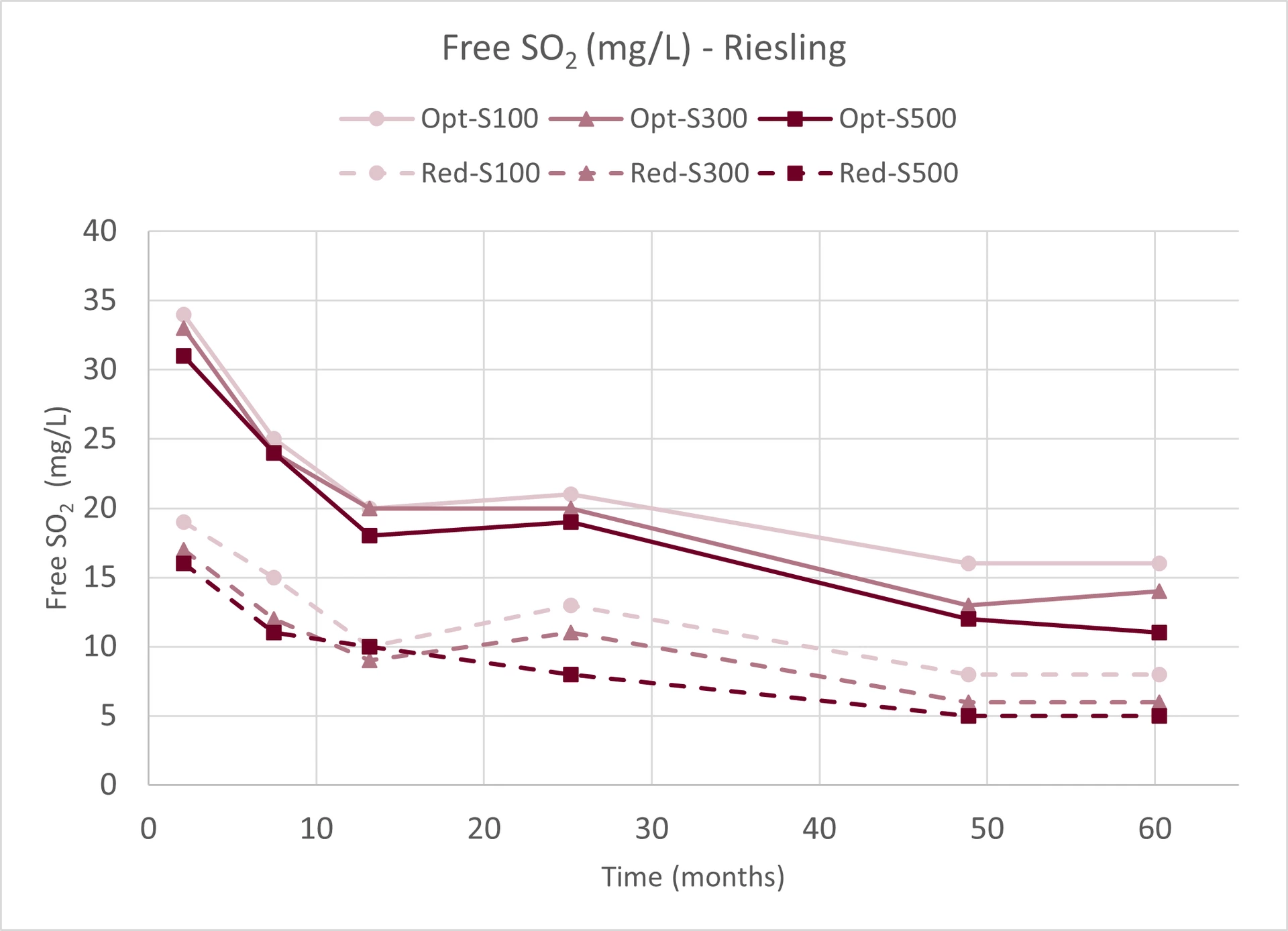
Free SO₂ (mg/L) over 60 months · Optimised vs Reduced sulphiting · Select 100, 300 & 500 closures
Figure 2: Change in Colour Intensity (DO420) — Gewurztraminer
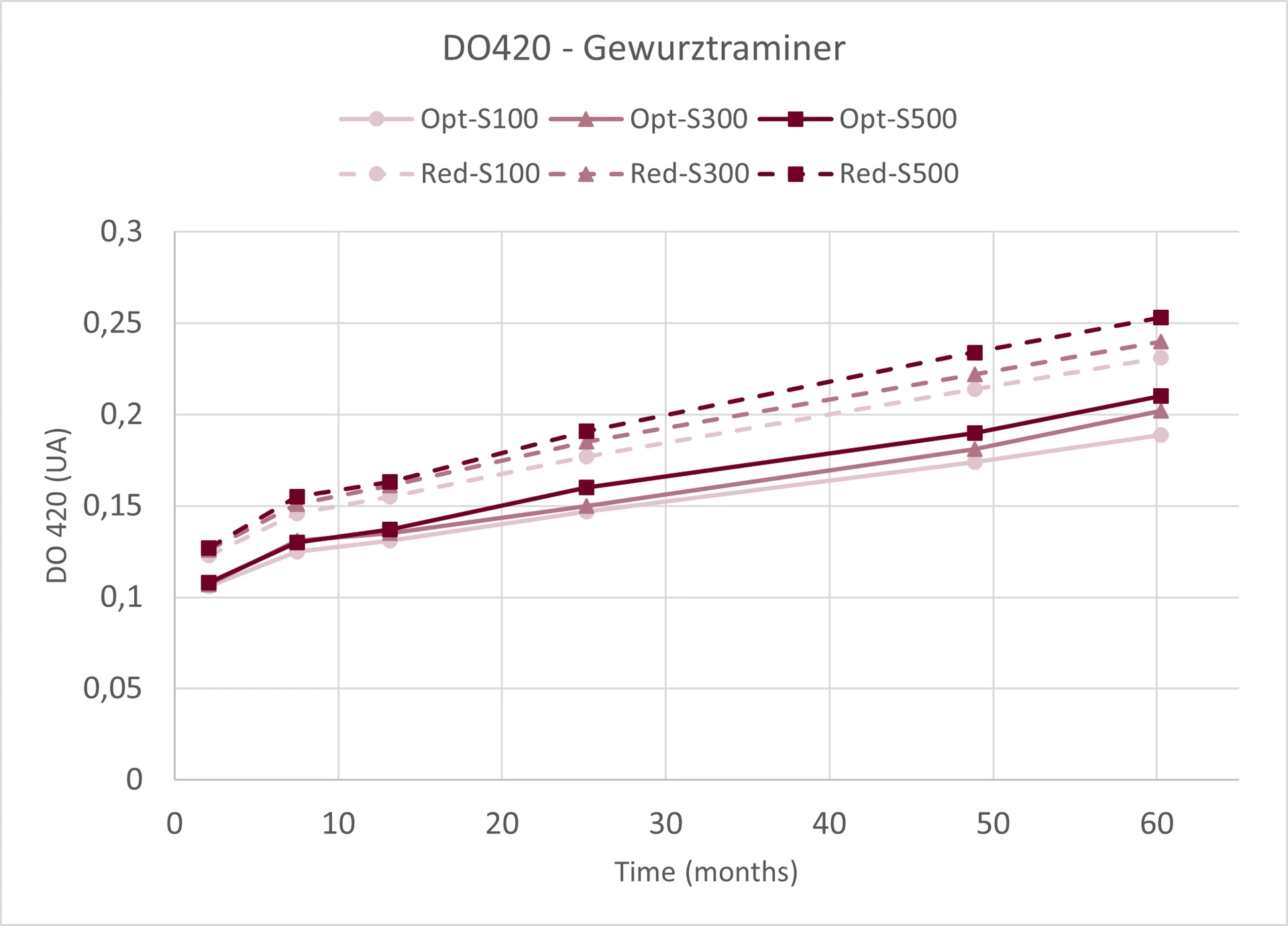
DO 420 (UA) over 60 months · Optimised vs Reduced sulphiting · Select 100, 300 & 500 closures
🍷 Change in the Organoleptic Characteristics of the Wines
Impact of the Sulphiting Methods
The wines of the two grape varieties, each produced using two different sulphite management methods, developed in different ways. The "quality" descriptor for the wines was chosen to evaluate the balance between the profile tasted and the profile expected by the jury for each variety — a reducing profile with mineral notes for the Rieslings and a more open profile with floral notes for the Gewurztraminers.
The quality of the wines was maintained during the first 4 years; it improved a little for the Riesling during the first two years with the emergence of mineral notes. It was only after 5 years that the wines displayed signs of change and an increase in the intensity of oxidation.
The quality of the wines was fairly close to the reference wines at first tasting. For the Gewurztraminer, it deteriorated quite rapidly due to more oxidising notes. For the Riesling, the variation was less significant because the oxidative nature was attenuated by the appearance of mineral notes.
Figure 3: Change in Overall Quality Rating of the Wines
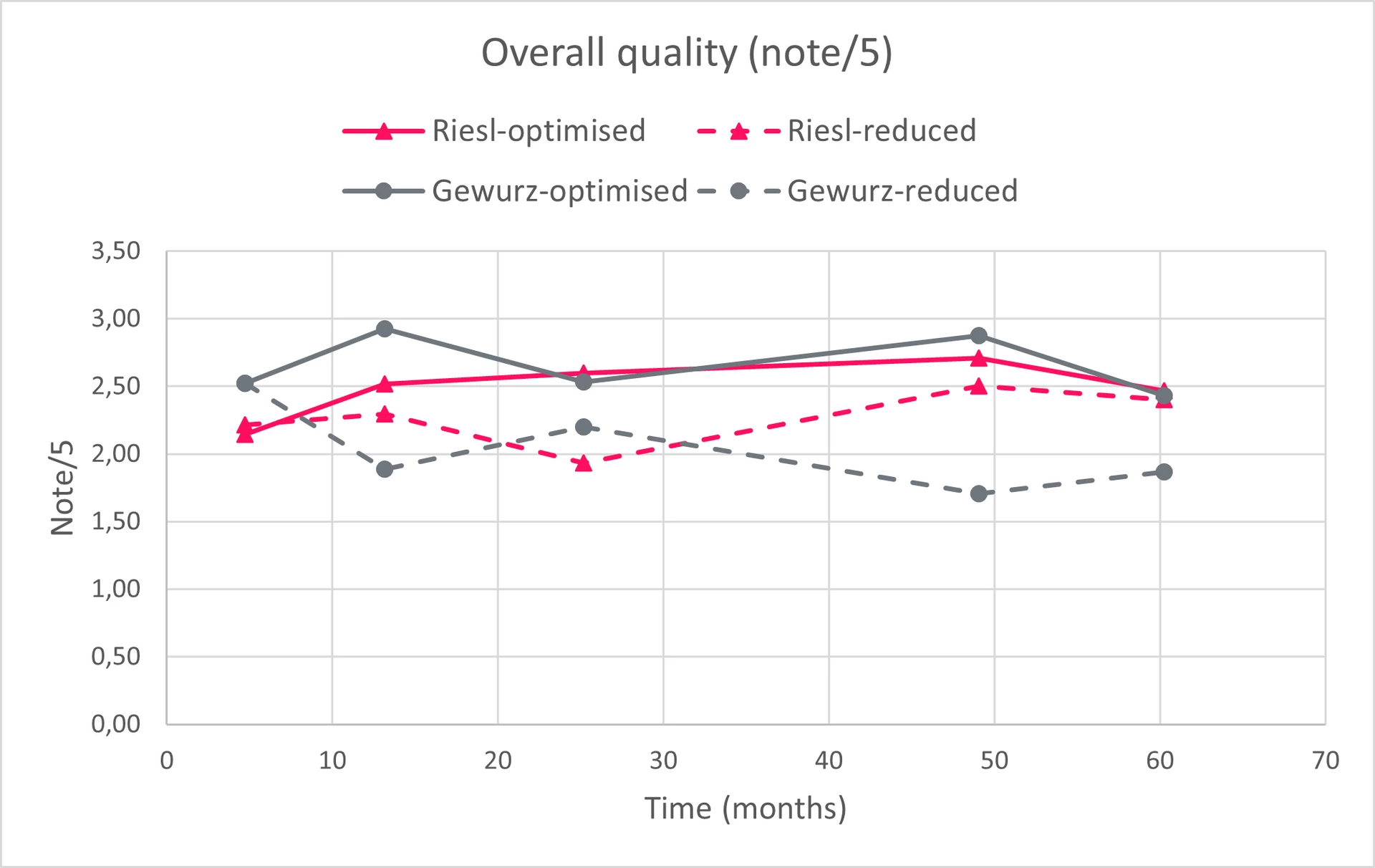
Overall quality (note/5) · Average for the three closures · Riesling & Gewurztraminer · Optimised vs Reduced
Figure 4: Change in Intensity of Oxidisation
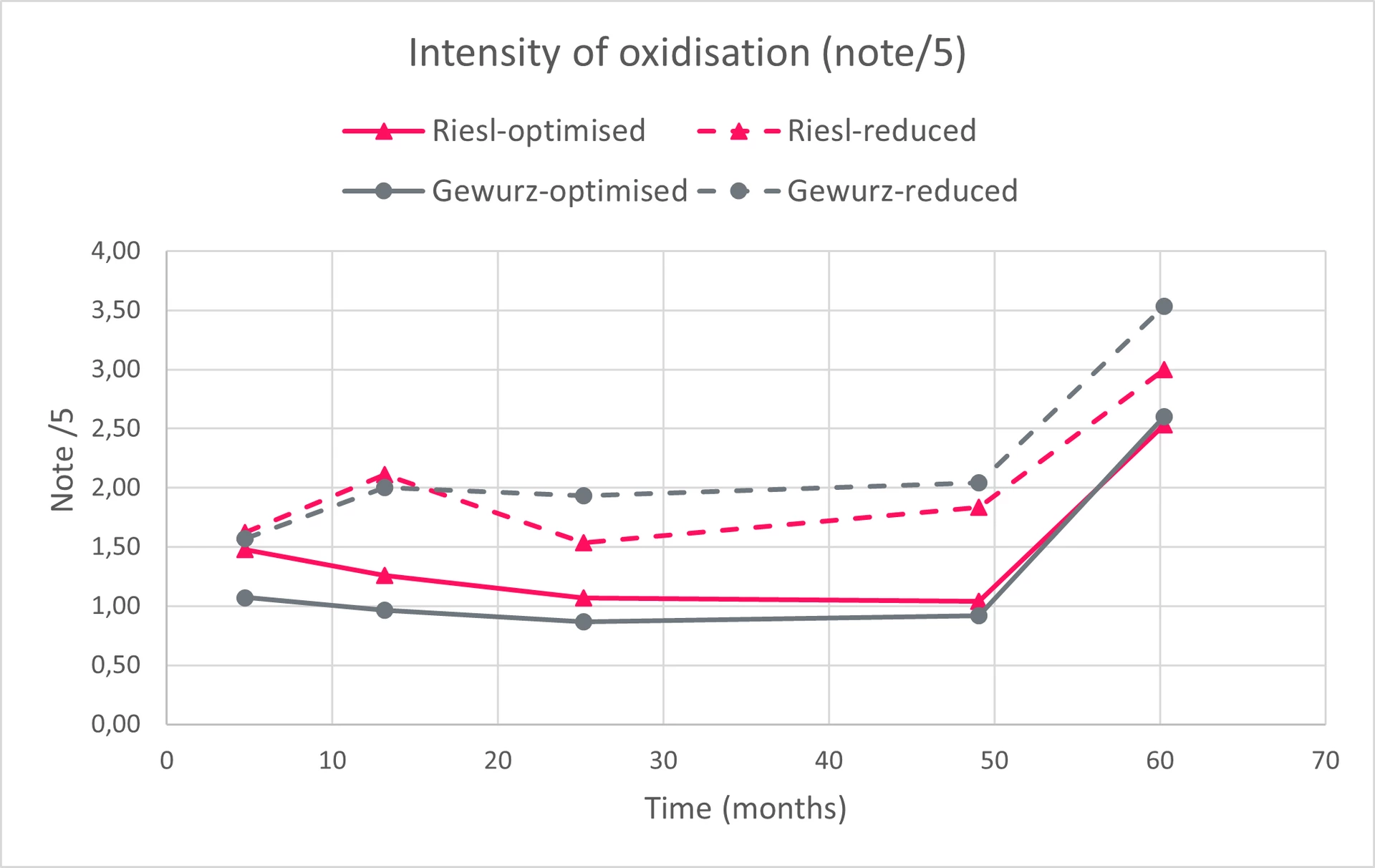
Intensity of oxidisation (note/5) · Average for the three closures · Riesling & Gewurztraminer · Optimised vs Reduced
🔒 Effect of the Closures
During the first tasting, 5 months after bottling, there was no difference between the closures, due to the impact of the TPO (intake of O₂ during bottling) at this point of conservation. Subsequently, the impact of the closure depended on both the grape variety and sulphiting management method.
🍇 Riesling
The quality of the wine had already deteriorated by the second tasting with the closure that is more permeable to oxygen. This was especially evident with reduced sulphiting. Conversely, with the least permeable closure, the quality improved after 12 months and remained stable over time. With intermediate permeability, the wine fluctuated between reducing and open profiles depending on the sulphiting method used.
🍇 Gewurztraminer
Despite slightly higher oxidisation intensity, the wines sealed with the most permeable closure were preferred during the first three tastings. They displayed fruitier and spicier aromatic notes that disappeared subsequently. After 4 years, the intermediate closure was preferred with optimised sulphating, and the least permeable closure when sulphating was reduced.
Figure 5: Overall Quality by Closure & Sulphite Management — Riesling
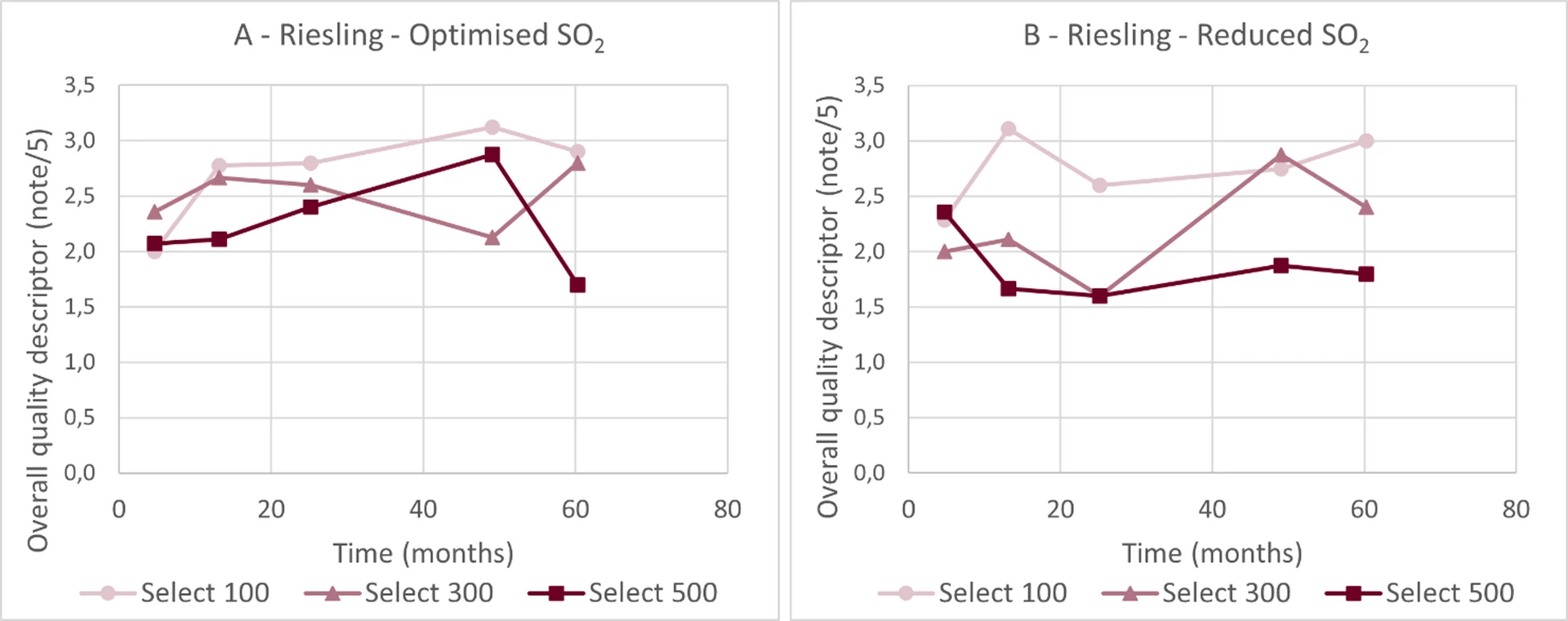
A = Riesling with optimised sulphiting · B = Riesling with reduced sulphiting · Select 100, 300 & 500
Figure 6: Overall Quality by Closure & Sulphite Management — Gewurztraminer
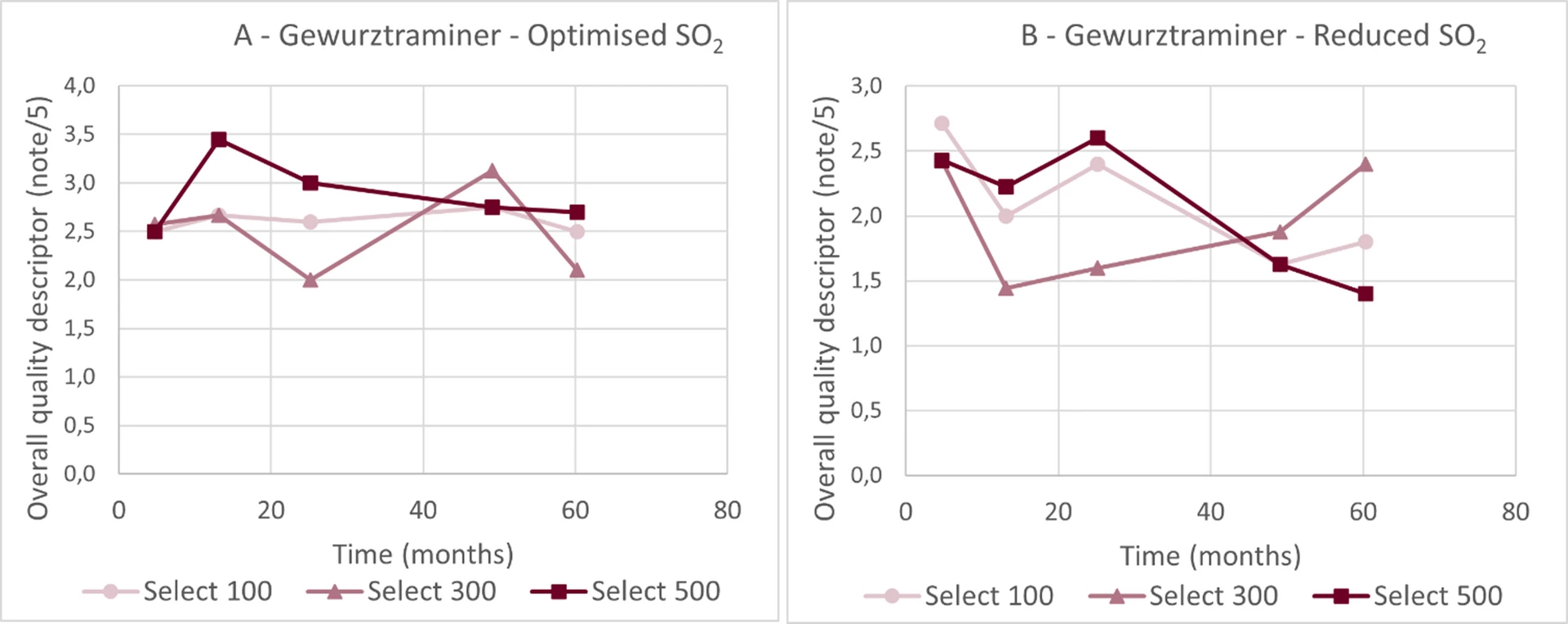
A = Gewurztraminer with optimised sulphiting · B = Gewurztraminer with reduced sulphiting · Select 100, 300 & 500
📋 Key Findings — Optimal Closure by Wine Type
The reduction of SO₂ during the winemaking process led to a quicker change in the wines which were logically more sensitive to oxidation. However, differences in behaviour emerged between the two grape varieties studied. The Riesling was more sensitive to oxidisation and could tolerate a slight reduction. The least permeable closures adapted better to this grape variety, especially for long-keeping wines. However, they were not suitable for the Gewurztraminer because they tended to cause tastes related to reduction. This grape variety is more sensitive to reduction and tolerates slight oxidisation better.
📚 Bibliography
- Ansen, D., & Pinsun, M. (2009). Résultats préliminaires de la comparaison de différents obturateurs en Alsace. Les Vins d'Alsace, (4), 18-22.
- Caillé, S., et al. (2010). Sensory characteristics changes of red Grenache wines submitted to different oxygen exposures pre and post bottling. Analytica chimica acta, 660(1-2), 35-42.
- Diéval, J. B., Vidal, S., & Aagaard, O. (2011). Measurement of the oxygen transmission rate of co-extruded wine bottle closures using a luminescence-based technique. Packaging Technology and Science, 24(7), 375-385.
- Dimkou, E., et al. (2013). Impact of dissolved oxygen at bottling on sulfur dioxide and sensory properties of a Riesling wine. American Journal of Enology and Viticulture, 64(3), 325-332.
- Dimkou, E., et al. (2011). Impact of headspace oxygen and closure on sulfur dioxide, color, and hydrogen sulfide levels in a Riesling wine. American Journal of Enology and Viticulture, 62(3), 261-269.
- Pinsun, M. (2010). Résultats après 36 mois de vieillissement de gewurztraminer et de riesling fermés avec différents obturateurs. Le Paysan du Haut-Rhin, 18-19.
- Pinsun, M. (2012). Qualité des vins. Quel bouchon pour quel vin ? L'Est Agricole et Viticole (27), 46.
- Ugliano, M. (2013). Oxygen contribution to wine aroma evolution during bottle aging. Journal of agricultural and food chemistry, 61(26), 6125-6136.
- Ugliano, M., et al. (2012). Oxygen consumption and development of volatile sulfur compounds during bottle aging of two Shiraz wines. Journal of agricultural and food chemistry, 60(35), 8561-8570.
- Ugliano, M., et al. (2011). Evolution of 3-mercaptohexanol, hydrogen sulfide, and methyl mercaptan during bottle storage of Sauvignon blanc wines. Journal of agricultural and food chemistry, 59(6), 2564-2572.
- Wirth, J., et al. (2012). Impact of post-bottling oxygen exposure on the sensory characteristics and phenolic composition of Grenache rosé wines. Food Chemistry, 132(4), 1861-1871.
- Wirth, J., et al. (2010). The impact of oxygen exposure before and after bottling on the polyphenolic composition of red wines. Food Chemistry, 123(1), 107-116.
Looking for the Right Closure for Your Wines?
Contact the Elipack team for expert guidance on Nomacorc closures tailored to your grape variety, winemaking style, and ageing objectives.
Source: Vinventions — Technical Articles (eu.vinventions.com)